If you work as an employee, your employer handles tax withholding automatically. But as a freelancer or independent contractor, that responsibility falls on you, and the W-9 is one of the first forms you’ll encounter in that process.
Clients request W-9s routinely, and many contractors fill them out without fully understanding what the form does, how it affects their taxes, or what happens if they don’t have the right information on hand. This guide covers all of it.
What Is a W-9 Form?
Form W-9, officially titled “Request for Taxpayer Identification Number and Certification,” is a document a client or business uses to collect your tax identification information before making payments to you. It captures your name, address, business entity type, and either your Social Security number or Employer Identification Number.
The W-9 itself never gets sent to the IRS. Instead, your client keeps it on file and uses the information on it when they prepare and file a 1099 information return reporting what they paid you. Think of it as the source document behind the 1099 you’ll eventually receive.
What Is a W-9 Used For?
Businesses are required to report payments made to contractors and freelancers to the IRS. To do that accurately, they need your taxpayer identification information, which is what the W-9 provides.
When a client pays you for services, they need your TIN to file a 1099-NEC with the IRS reporting the amount paid. The W-9 is how they get it. Without a completed W-9 on file, a client may be required to withhold a flat 24 percent backup withholding rate from your payments and remit it directly to the IRS, which is a situation you generally want to avoid.
One important update to know: the OBBBA raised the 1099 reporting threshold from $600 to $2,000 for many types of payments made after 2025. This means clients won’t be required to issue a 1099-NEC until they’ve paid you more than $2,000 in a calendar year, up from the longstanding $600 threshold. The W-9 requirement doesn’t disappear at lower amounts, but the threshold change does affect when clients are obligated to file the associated information return.
Who Needs to Fill Out a W-9?
You’ll typically be asked to complete a W-9 when you are:
- A freelancer or independent contractor receiving payment for services
- A sole proprietor or single-member LLC owner receiving business income
- A vendor or service provider being paid by a business that needs to file a 1099
- A person receiving other reportable payments such as rent, royalties, or prize winnings
If you’re a U.S. person, meaning a U.S. citizen, resident alien, or domestic business entity, you use the W-9. Non-U.S. persons use a different form series, the W-8, to document their foreign status.
How to Get a W-9
The current version of Form W-9 is always available for free on the IRS website. The most recent revision is dated March 2024 and reflects updated guidance for LLCs and flow-through entities. Always make sure you’re using the current version, since outdated versions may be rejected by clients or payors.
You can complete the form digitally and return it electronically, or print and sign it by hand. Once you’ve filled it out for the first time, save a copy so you have it ready the next time a client requests one.
How to Fill Out a W-9
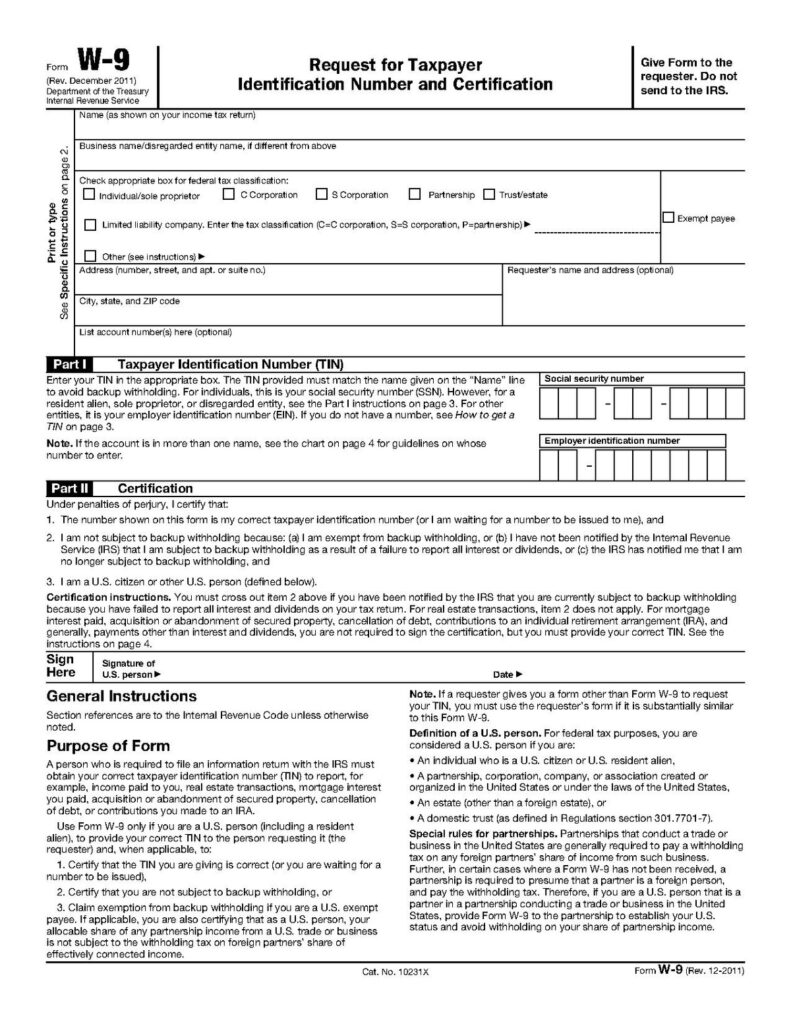
Filling out a W-9 is straightforward for most freelancers and sole proprietors. Here’s what each section requires:
Line 1: Name. Enter your full legal name as it appears on your tax return. If you operate under a business name, your legal name still goes here.
Line 2: Business name. If you do business under a name different from your legal name, such as a DBA, enter it here. If not, leave it blank.
Line 3: Federal tax classification. Check the box that describes your tax status. Most freelancers and independent contractors will check “Individual/sole proprietor or single-member LLC.” Partnerships, C corporations, S corporations, and trusts have their own checkboxes.
Line 3b (new as of 2024). This checkbox applies to partnerships, trusts, and estates, including LLCs taxed as partnerships, that have foreign partners, owners, or beneficiaries. Most individual freelancers will leave this blank.
Line 4: Exemptions. Most individual freelancers and sole proprietors leave this section blank. Exemptions apply primarily to corporations and certain other entities.
Lines 5 and 6: Address. Your current mailing address.
Part I: Taxpayer Identification Number. This is the most important section. Enter either your Social Security number or your Employer Identification Number, depending on your situation.
One clarification the IRS has reinforced in recent form updates: sole proprietors must provide their SSN here, not their business EIN. If you’re a sole proprietor or a single-member LLC that is a disregarded entity for tax purposes, the IRS requires the owner’s SSN, not the entity’s EIN, for payee identification purposes. Using an EIN in this field when an SSN is required is a common error that can create backup withholding issues.
Part II: Certification. Sign and date the form certifying that the information you’ve provided is accurate and that you’re not subject to backup withholding.
How Does a W-9 Affect Your Taxes?
The W-9 itself doesn’t directly change what you owe. What it does is set the chain of events in motion that results in your income being reported to the IRS.
When a client files a 1099-NEC using the information from your W-9, the IRS receives a record of what you were paid. Your Schedule C needs to account for that income accurately. If there’s a mismatch between what clients reported paying you and what you reported earning, the IRS will notice.
The downstream tax implications of receiving 1099 income are significant. As a self-employed individual, you’re responsible for paying both income tax and self-employment tax on your net earnings. Self-employment tax runs 15.3 percent on net profit, covering both the employee and employer portions of Social Security and Medicare. If you expect to owe more than $1,000 in taxes for the year, you’re generally required to make quarterly estimated tax payments to avoid underpayment penalties.
Understanding the full scope of self-employed tax deductions available to you is one of the most effective ways to reduce the tax impact of 1099 income. Every legitimate business expense that reduces your net profit also reduces both your income tax and self-employment tax liability.
What If You Don’t Provide a W-9?
If you refuse to provide a W-9 when a client requests one, the client is generally required to apply backup withholding at a flat rate of 24 percent on your payments and remit that amount directly to the IRS. You’d then need to reconcile that withholding when you file your return. It’s an avoidable hassle. Providing the form promptly keeps the payment process clean for both parties.
W-9 vs. W-4: What’s the Difference?
These two forms are often confused. A W-4 is completed by employees and tells their employer how much federal income tax to withhold from each paycheck. A W-9 is completed by independent contractors and provides taxpayer identification information to clients who need to file information returns. If you’re asked to fill out a W-9, you’re being treated as a contractor, not an employee, which has significant implications for how your taxes work.
If you believe you’re being misclassified as an independent contractor when you should be treated as an employee, that’s worth discussing with a tax professional. Worker classification affects not just your tax obligations but also your eligibility for certain benefits and legal protections.
Keep Your W-9 Information Current
If your legal name, address, or tax identification number changes, update your W-9 and provide a new copy to any clients who have the old version on file. Stale information on a W-9 can lead to mismatched 1099s, which can trigger IRS notices or delays in processing your return.
Get Help With Freelancer Taxes
The W-9 is just the entry point into a broader set of tax responsibilities that come with self-employment. From quarterly estimated payments to maximizing deductions to understanding how your entity structure affects what you owe, there’s a lot to manage, and getting it right from the start saves significant time and money.
Schedule a one-on-one strategy session with the Shared Economy Tax team to get personalized guidance on your freelance tax situation.
